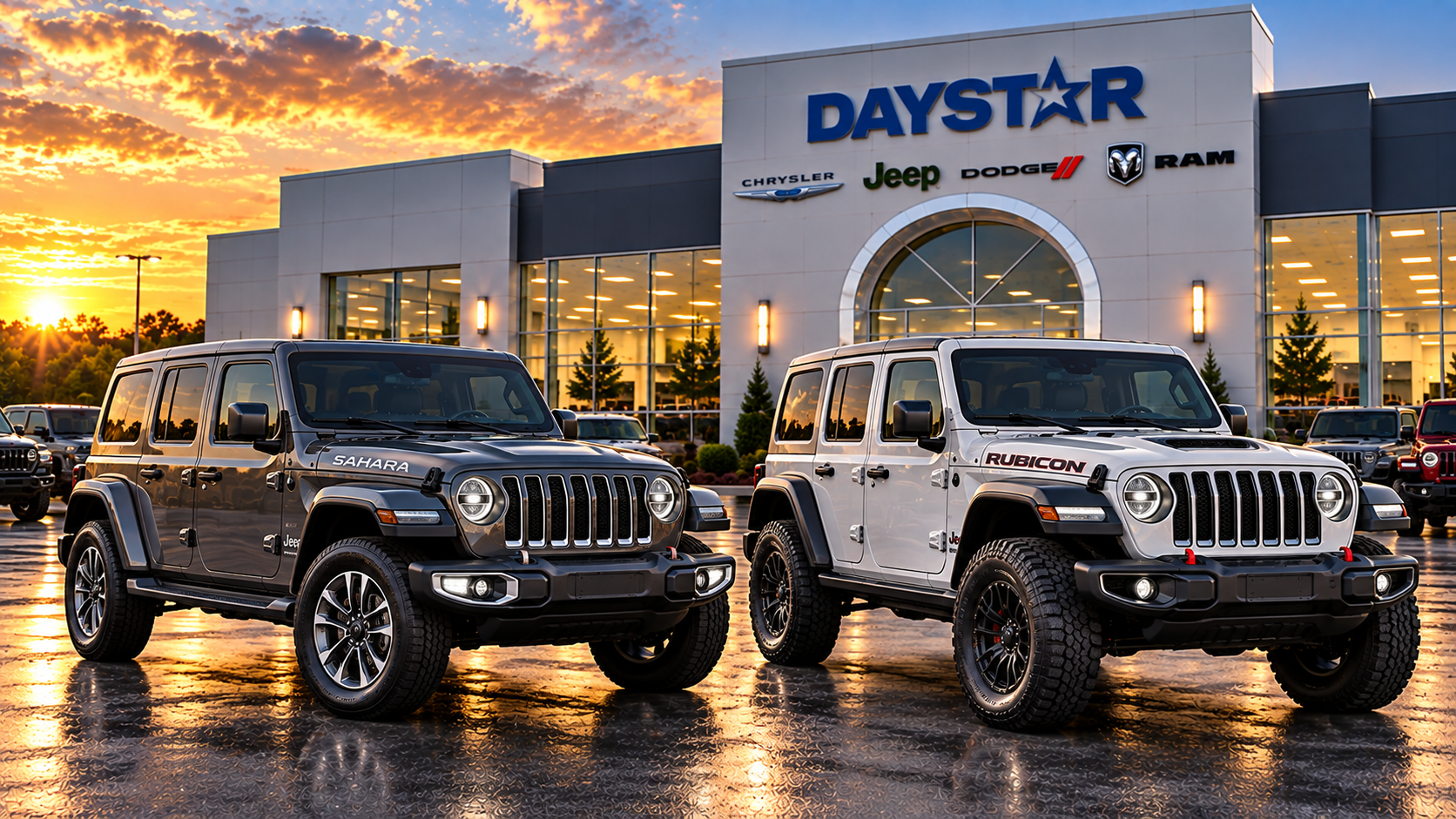
The main difference between the Jeep Wrangler Sahara and Rubicon is their intended driving purpose. The Sahara is built primarily for daily comfort, featuring 18-inch wheels with all-season highway tires, refined cabin appointments, and a Command-Trac 4WD system. The Rubicon is designed for maximum o ff-road capability, adding heavy-duty Dana 44 axles, front and rear electronic locking differentials, an electronic front sway bar disconnect, a Rock-Trac 4WD system with a 4:1 low-range ratio, and 33-inch all-terrain tires. Choosing between these two legendary four-wheel-drive SUVs comes down to how you plan to spend your time behind the wheel. Drivers who spend the vast majority of their week on paved highways, suburban streets, or gravel county back roads usually prefer the Sahara. Available exclusively as a 4-door body style, it delivers smooth highway ride quality, quieter cabin acoustics, and high-end standard convenience items. For buyers interested in plug-in hybrid efficiency alongside premium features, you can also explore Jeep 4xe hybrid options offered on the Sahara platform to find the best fit for your needs. Conversely, the Rubicon is engineered from the frame up to tackle technical rock crawling, steep mud trails, and severe off-road obstacles. Available in both 2-door and 4-door configurations, it sacrifices a small degree of highway softness in exchange for heavy-duty hardware that protects mechanical components when the pavement ends. To help local buyers compare both models side-by-side on identical road surfaces, our team at Daystar Chrysler Dodge Jeep Ram maintains a diverse showroom inventory. You can stop by our Malvern showroom location to walk around both trims, or call (330) 863-1144 to speak directly with our Jeep specialists. Table of Contents How Do Ground Clearance, Axle Ratios, and Sway Bar Disconnects Differ? What Engine and Transmission Options Are Offered on Sahara vs. Rubicon? What Tires Come Standard, and How Do Maintenance and Insurance Costs Compare? What Should Buyers Inspect When Test-Driving a Sahara vs. Rubicon on Paved Roads? Questions Buyers Ask Most About Wrangler Sahara and Rubicon Trims Where Can Buyers Near Malvern Test Drive and Compare Wrangler Sahara and Rubicon Trims? How Do Ground Clearance, Axle Ratios, and Sway Bar Disconnects Differ? The Rubicon provides roughly 11 inches of standard ground clearance, a 4.10 axle ratio, and an electronic sway bar disconnect, whereas the Sahara offers about 10 inches of ground clearance, a 3.45 axle ratio, and a fixed front stabilizer bar. These mechanical variances fundamentally alter how each SUV handles steep inclines, deep ruts, and trail obstacles. Ground clearance differences stem directly from each trim's factory suspension height and tire diameter. The Sahara rides on 32-inch all-season tires that provide ample chassis height for snowstorms and unpaved farm paths around Malvern, while keeping the stepping height manageable for passengers. The Rubicon sits higher from the factory to clear its standard 33-inch off-road tires, and optional factory packages increase tire size to 35 inches for up to nearly 13 inches of total obstacle clearance. Axle gearing and transfer case ratios further separate their mechanical personalities: Sahara Drivetrain: Uses a Command-Trac 4WD or available Selec-Trac full-time system with a 2.72:1 low-range ratio and a 3.45 axle ratio. This setup optimizes engine RPMs for highway fuel economy and smooth acceleration. Rubicon Drivetrain: Uses a Rock-Trac 4WD system with a heavy-duty 4:1 low-range ratio and a standard 4.10 axle ratio (with optional 4.56 or 4.88 ratios). This creates extreme crawl ratios, allowing the vehicle to creep down rocky descents at single-digit speeds without constant brake application. The electronic front sway bar disconnect is exclusive to the Rubicon trim and cannot be equipped on a standard Sahara. By pushing a dash-mounted switch in 4LO or 4HI, the driver mechanically decouples the front stabilizer bar, allowing the front axle to articulate significantly further over boulders and deep ditches to keep all four tires grounded. For shoppers seeking versatile all-weather capability without extreme rock-crawling gear, browsing our pre-owned Jeep Cherokee inventory offers another excellent four-wheel-drive alternative. What Engine and Transmission Options Are Offered on Sahara vs. Rubicon? The Sahara comes standard with a 2.0L turbocharged four-cylinder engine paired exclusively with an eight-speed automatic transmission, while the Rubicon offers multiple powertrains including a 3.6L Pentastar V6 with an available six-speed manual transmission. Buyers seeking three pedals on the floor must choose a V6-equipped Rubicon or lower trim, as the manual gearshift is not offered on the Sahara. Engine specifications across the core lineup deliver strong output tailored to distinct driving styles: 2.0L Turbocharged I-4: Generates 270 hp and 295 lb-ft of low-end torque. Standard on Sahara and available on Rubicon, this motor builds boost quickly for brisk city passing and responsive trail power. 3.6L Pentastar V6: Produces 285 hp and 260 lb-ft of torque. Standard on 2-door Rubicon models and widely available across the 4-door Rubicon line, this naturally aspirated V6 provides linear throttle control and allows pairing with either a six-speed manual transmission or an eight-speed automatic transmission. 6.4L Hemi V8: Reserved exclusively for the range-topping Rubicon 392, delivering 470 hp and 470 lb-ft of torque for maximum acceleration. Both trims deliver a maximum published towing capacity of 3,500 lb when properly equipped with factory receiver hitches and trailer tow packages, making either model capable of hauling light utility trailers, fishing boats, or camper setups. To assist owners in maintaining their drivetrain, our dealership makes it easy to order genuine Mopar parts directly through our service center. We invite local drivers to learn more about our dealership's mission and values as a trusted community automotive partner. What Tires Come Standard, and How Do Maintenance and Insurance Costs Compare? The Sahara comes standard with 18-inch aluminum wheels wrapped in 255/70R18 all-season tires, while the Rubicon features 17-inch wheels mounted to 33-inch BFGoodrich all-terrain or mud-terrain tires. Due to these wheel and tire configurations, the Rubicon generally incurs higher routine maintenance replacement expenses and slightly elevated auto insurance premiums. Comparing long-term ownership costs reveals key operational differences between the two models: Cost Factor Jeep Wrangler Sahara Jeep Wrangler Rubicon Standard Wheel & Tire Size 18-inch aluminum wheels / 32-inch all-season tires 17-inch wheels / 33-inch tires (optional 35-inch) Tire Replacement Cost Moderate (standard highway tread design) Higher (specialized all-terrain/mud-terrain rubber) Tire Tread Wear Rate Longer pavement tread life Faster wear on asphalt due to deep tread blocks Insurance Premium Profile Standard SUV rating tier Slightly higher due to vehicle value & off-road equipment Gearing & Highway Fuel Use 3.45 axle ratio (optimized highway MPG) 4.10 axle ratio (higher engine RPM at 70 mph) Because the aggressive tread compounds on 33-inch or 35-inch off-road tires wear down faster on dry pavement, Rubicon owners who commute daily will replace tires more frequently than Sahara owners. Additionally, full-replacement costs for heavy-duty all-terrain tires run noticeably higher per set. Insurance underwriters typically assign slightly higher physical damage premiums to the Rubicon because of its higher initial purchase price, specialized electronic locking differentials, and increased exposure to off-road trail damage risks. What Should Buyers Inspect When Test-Driving a Sahara vs. Rubicon on Paved Roads? When evaluating a Sahara and a Rubicon on a paved test drive, buyers should pay close attention to tire hum, cabin wind noise, steering tracking on the highway, and suspension firmness over rough patches. The mechanical differences that make the Rubicon an off-road powerhouse create noticeable differences on blacktop. Our team recommends executing a specific evaluation checklist during your test drive: Highway Cruise Stability: Drive both vehicles at 65 to 70 mph along local state routes, such as the corridors through Minerva. Notice how the Sahara holds its lane with minimal steering correction, whereas the Rubicon 's taller stance and softer, knobby off-road tires require subtle steering inputs to maintain center. Cabin Noise Levels: Pay attention to ambient cabin sound at speed. The smooth highway tread on the Sahara keeps tire roar to a minimum. In contrast, the deep tread voids on the Rubicon 's 33-inch tires produce a distinct rhythmic hum that increases with vehicle speed. Suspension Dampening over Bumps: Pass over railroad tracks, expansion joints, or uneven pavement. The Sahara absorbs sharp impacts with a compliant, passenger-car-like dampening style. The Rubicon responds with a firmer, heavy-duty truck feel designed to withstand severe off-road bottoming. Turning Radius and Parking Effort: Test low-speed maneuvering in a parking lot. The Sahara turns smoothly with tight wheel articulation, while the Rubicon 's wider track and heavy-duty front axle components feel slightly heavier at the steering wheel. Shoppers interested in exploring our current factory-fresh inventory can view our online new Jeep Wrangler Rubicon selection before arriving for a road test. Questions Buyers Ask Most About Wrangler Sahara and Rubicon Trims Q: Is the Wrangler Sahara or Rubicon better for a daily commute? The Sahara is generally better suited for daily commuting because its 18-inch all-season tires, 3.45 axle ratio, and highway-tuned suspension provide a quieter cabin, smoother ride, and better pavement tracking. While the Rubicon can certainly be driven daily, its knobby 33-inch tires generate more road noise and wear faster on asphalt. Q: Does the Jeep Wrangler Sahara have a manual transmission option? No, the Sahara is offered exclusively with an eight-speed automatic transmission paired with the 2.0L turbocharged four-cylinder engine or 4xe plug-in hybrid powertrain. If you want a six-speed manual transmission, you must choose a Rubicon or Sport model equipped with the 3.6L Pentastar V6 engine. Q: Can I add the Sway Bar Disconnect feature to a Sahara trim? The electronic front stabilizer bar disconnect is a factory feature exclusive to the Rubicon trim and is not available from the factory on a Sahara. While aftermarket manual disconnect links can be installed on a Sahara, the push-button electronic system integrated into the dash and Uconnect display is unique to Rubicon models. Q: What mechanical warranty coverage comes on both Wrangler trims? Both the Sahara and Rubicon come backed by Jeep's standard factory warranty package, which includes a 3-year/36,000-mile basic limited warranty and a 5-year/60,000-mile powertrain limited warranty. Rust-through corrosion protection is covered for 5 years with unlimited mileage. To help plan your purchase around your monthly household budget, you can apply for competitive financing online prior to visiting our dealership. Q: How does choosing a Wrangler fit into environmental initiatives? Selecting a 4xe plug-in hybrid version of either the Sahara or Rubicon allows drivers to complete daily short-distance trips using purely electric power while retaining full four-wheel-drive trail capability. Customers can also learn about our carbon neutral program to explore how our dealership supports sustainable automotive practices. Where Can Buyers Near Malvern Test Drive and Compare Wrangler Sahara and Rubicon Trims? Buyers near Malvern can test drive and compare the full lineup of Jeep Wrangler Sahara and Rubicon models at Daystar Chrysler Dodge Jeep Ram. Located right on Alliance Road, our dealership regularly stocks both 2-door and 4-door configurations, including standard gas engine options and advanced 4xe plug-in hybrids. Evaluating both trims back-to-back on identical local roads is the absolute best way to decide which model fits your personal lifestyle. Whether you prefer the refined highway comfort of the Sahara for daily family driving or the heavy-duty Dana 44 axles and locking differentials of the Rubicon for weekend trail rides, our experienced team provides clear, straightforward guidance with zero pressure. When you are ready to take the next step: Visit our dealership address at 7157 Alliance Rd NW, Malvern, OH 44644 to compare vehicle windows, cabin features, and seating layouts. Give our sales team a call at (330) 863-1144 to confirm current vehicle availability or schedule a dedicated back-to-back road test. Bring your trade-in vehicle along so our appraisal team can provide a transparent market valuation while you are out on your test drive. © 2026 Daystar Chrysler Dodge Jeep Ram. All rights reserved. br>