



Daystar Chrysler Dodge Jeep Ram

Blog / New Vehicles

Blog

All New Vehicles Pre-Owned Vehicles Service & Maintenance Credit and Financing About Us Why Buy
Welcome to the Daystar Truck Center

Light Duty or Heavy Duty? How to pick the right truck!

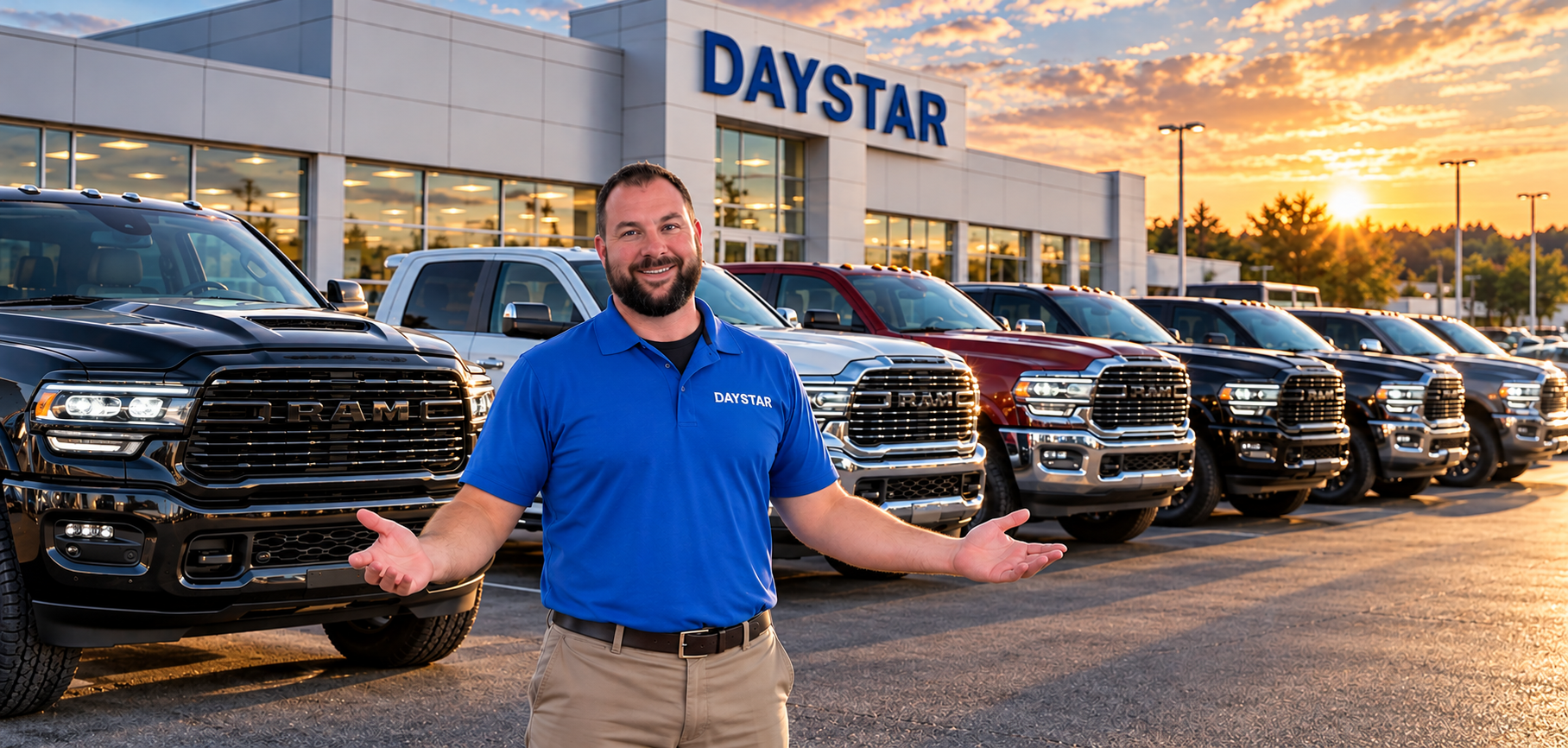
Light Duty or Heavy Duty? How to Pick the Right Truck Oct 15, 2026 · By Josh Peebles, Sales Consultant, Daystar Chrysler Jeep Dodge Ram Welcome to the Daystar Truck Center Hi, I'm Josh Peebles, Sales Consultant here at Daystar Chrysler Jeep Dodge Ram. One of the questions I hear most on our lot is simple: "Do I need a half-ton, or do I need a heavy duty?" It's a great question, and getting the answer right can save you thousands of dollars and a lot of headaches down the road. That's exactly why Daystar is a dedicated Truck Center. We keep a deep inventory of trucks on the ground, from everyday light-duty pickups to serious heavy-duty workhorses, and our team spends every day matching people with the right one. And while we're proud to be a Ram store, we sell all makes and models, new and pre-owned. If a Ford, Chevy, GMC, Toyota or anything else is the right fit for you, we'll help you find it. In this post, I'll walk you through the two numbers that matter most when choosing a truck, towing capacity and payload, and show you how they separate light duty from heavy duty, using the Ram lineup as our example. Towing vs. Payload: The Two Numbers That Matter Before we talk trucks, let's get the terms straight. These two numbers decide whether a light duty will do the job or whether you need to step up. Towing capacity is how much weight your truck can pull behind it: a camper, a boat, a horse trailer, an equipment trailer. Payload capacity is how much weight your truck can carry in the cab and bed combined. That includes you, your passengers, your toolbox, a load of mulch, and the tongue weight of whatever you're towing. That last part trips a lot of people up. When you hook up a trailer, roughly 10 to 15 percent of its weight presses down on the hitch (and closer to 15 to 25 percent for a fifth-wheel or gooseneck). All of that counts against your payload. So a 9,000-pound camper can put 900 to 1,350 pounds on your truck before anyone even climbs in. You'll also see two other ratings on the door sticker. GVWR (Gross Vehicle Weight Rating) is the most your truck can weigh fully loaded. GCWR (Gross Combined Weight Rating) is the most your truck and trailer can weigh together. Stay under both, and you're towing safely. Light Duty: The Everyday Workhorse (Ram 1500) A light-duty, or half-ton, truck is the right pick for most drivers. It rides smoothly, it's easy to park, it gets better fuel economy, and it still handles serious work on the weekend. The 2027 Ram 1500 is a great example. When properly equipped, it tows up to 11,530 pounds with the 3.0L Hurricane twin-turbo inline-six, and it carries up to 2,340 pounds of payload with the 3.6L Pentastar V6. Depending on the engine you choose, you can also get the 5.7L HEMI V8 or the high-output Hurricane, and each one carries its own ratings. A Ram 1500 is likely your truck if you: Drive it every day to work, school and practice Tow a boat, a pair of jet skis, a utility trailer or a mid-size travel trailer Haul weekend projects: lumber, landscaping supplies, dirt bikes Want a comfortable family vehicle that can still work hard One tip: those maximum numbers come from specific configurations. Cab size, bed length, axle ratio and trim all change the real number on your truck, so always check the door sticker on the exact truck you're buying. Heavy Duty: When the Job Gets Bigger (Ram 2500 and 3500) Heavy-duty trucks are built with stronger frames, bigger brakes, heavier axles and higher GVWRs. That's what lets them safely handle loads a half-ton shouldn't. Ram 2500 (three-quarter ton). According to Ram's preliminary 2027 Heavy Duty figures, the 2500 with the 6.7L Cummins High-Output turbo diesel tows up to 20,000 pounds. With the 6.4L HEMI V8 and the new Payload Upgrade Package, it carries up to 4,580 pounds of payload. It also keeps a coil-spring rear suspension, so it rides better than you'd expect from a truck this strong. Ram 3500 (one ton). This is the top of the pickup mountain. The 3500 with the Cummins HO tows up to 37,020 pounds with a fifth-wheel or gooseneck, and the HEMI-powered 3500 carries up to 7,580 pounds of payload. It's available in single rear wheel or dually configurations. A Ram 2500 is likely your truck if you: Tow a large travel trailer, a toy hauler or a loaded equipment trailer regularly Carry heavy loads in the bed and tow at the same time Need a truck that won't be working at its limit every trip A Ram 3500 is likely your truck if you: Pull a big fifth-wheel camper, a multi-horse living-quarters trailer or a gooseneck flatbed Run a business hauling equipment, livestock or materials Plan to carry a slide-in truck camper, which can eat up thousands of pounds of payload on its own Quick Guide: Which Truck Fits You? Here's how the Ram lineup stacks up at its maximums, when properly equipped: Truck Class Max towing (lb) Max payload (lb) Best for 2027 Ram 1500 Light duty (half ton) 11,530 2,340 Daily driving, boats, mid-size campers 2027 Ram 2500 Heavy duty (3/4 ton) 20,000 4,580 Big travel trailers, toy haulers, work trailers 2027 Ram 3500 Heavy duty (1 ton) 37,020 7,580 Fifth-wheels, goosenecks, truck campers, commercial work 2500 and 3500 figures are Ram's preliminary 2027 ratings. Maximum towing and maximum payload usually come from different configurations. Before you come in, ask yourself these questions: What's the heaviest thing I'll tow, and how much does it weigh loaded, not empty? Is it a bumper-pull trailer or a fifth-wheel or gooseneck? How many people and how much gear will ride along when I tow? How often will I tow: a few times a year, or every week? Do I plan to upgrade to a bigger camper or trailer in the next few years? A good rule of thumb: keep your loaded trailer at or below about 80 percent of your truck's rated capacity. That margin makes for easier stopping, better control in wind and on hills, and less wear on your truck. If your answers push you close to a light-duty truck's limits, it's time to look at heavy duty. Let Us Help You Find the Right Truck Picking a truck shouldn't be guesswork. At the Daystar Truck Center, we'll look at what you tow, what you haul and how you drive, then match you with the truck that fits, whether that's a Ram 1500, a Cummins-powered 3500 dually, or something in between. And remember, we sell all makes and models. If the right truck for you wears a Ford, Chevy, GMC, Toyota or Nissan badge, we'll help you find that too, new or pre-owned. Our goal is simple: you drive off our lot in a truck that's built for your life. Stop by, give us a call, or browse our inventory online. Bring your trailer specs with you, and let's find your truck. Josh Peebles Sales Consultant, Daystar Chrysler Jeep Dodge Ram Sources 2027 Ram 1500 – Ram Trucks 2027 Ram 1500 Professional – Ram Trucks What's New for 2027: Ram Heavy Duty – Stellantis Media
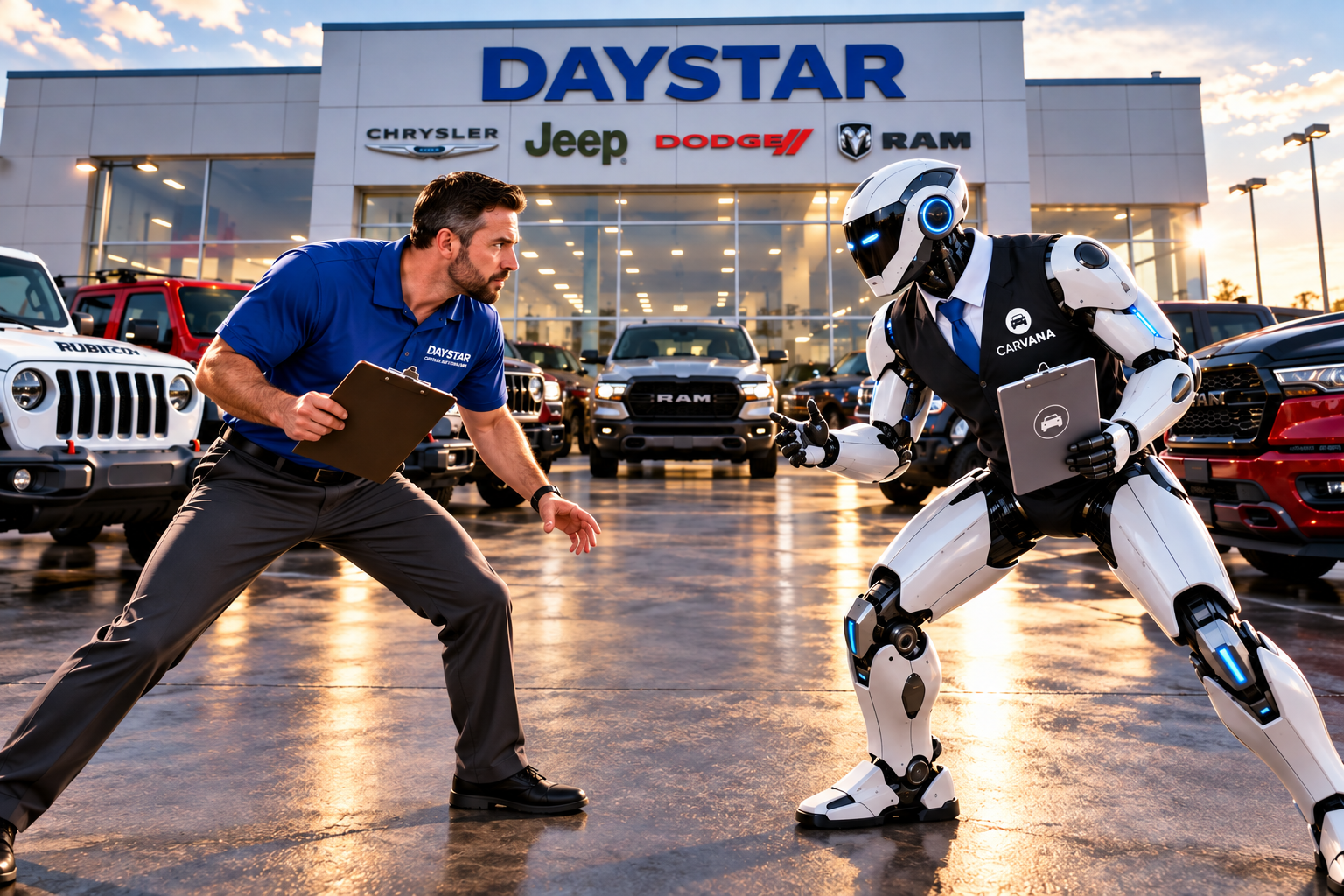
Daystar vs. Carvana

Why buy at Daystar vs. Carvana?

Why Buy Local: The Case for Daystar CDJR Over Carvana Oct 7, 2026 ·Dan Millat, General Manager A local franchised dealer like Daystar Chrysler Dodge Jeep Ram gives you three things Carvana's online model cannot: a test drive before you pay, a price you can negotiate, and a service department a short drive away that stands behind the sale. You drive it before you own it At a dealership, the test drive comes before the paperwork. You sit in the seat, check the sightlines, back a trailer up to the hitch, and listen for anything that sounds wrong. If two trims are on the lot, you can drive both in one afternoon. Carvana flips that order. You buy first, and its 7-day return window stands in for the test drive. That window is capped at 400 miles, with a $1 charge for each mile over, and you must start the return by 8 p.m. Eastern on day seven. Returning a car is also a bigger job than declining one. Financing and registration have to be unwound, and a refund can take 10 to 15 business days. At Daystar, a vehicle that does not feel right costs you nothing but the drive to Malvern. New vehicles, factory incentives and custom orders Daystar is a franchised Chrysler, Dodge, Jeep and Ram dealer, so new Ram 1500s, Jeep Wranglers, Dodge Chargers and Chrysler Pacificas are its core business. Buying new at Daystar comes with: The full factory warranty, starting from mile one. Manufacturer rebates and special financing on new vehicle s. Custom orders. Daystar will order a vehicle from the factory in the color, trim and options you want. Certified pre-owned vehicles, backed by the manufacturer rather than a third party. Commercial trucks and vans, including Ram chassis cabs and ProMaster vans for business buyers. Daystar also stocks used vehicles, including a selection under $20,000, so you can compare new against used on the same lot. Service after the sale The biggest difference shows up after you drive home. Daystar has its own service and parts departments on site, with two Level 3 Chrysler Master Certified Technicians on staff. The people who sold you the vehicle work in the same building as the people who fix it. That matters most for warranty work. Factory warranty repairs and recalls on Chrysler, Dodge, Jeep and Ram vehicles are done at franchised dealers, with factory parts and diagnostic equipment. Daystar also offers rental vehicles while yours is in the shop. Carvana has no service department. Its 100-day, 4,189-mile limited warranty is administered by a separate company, SilverRock, through a network of approved repair shops. Motor1 reported a $100 deductible at in-network shops and $350 elsewhere. That same Motor1 story shows what the gap can look like. A buyer found a fuel leak within days, and the nearest in-network shop was 90 minutes away. Her choices were a tow, paying her own mechanic and waiting for reimbursement, or returning the car. Price, fees and trade-ins Carvana's price is fixed. The listed price, the delivery fee and the doc fee are all non-negotiable, so the number on the screen is the only number you will get. A dealership sale is a conversation. The vehicle price, your trade-in value and your financing can each be discussed, and factory incentives can come off the top. CarWhere's review of 3,233 verified deals found half of new-car buyers paid at least 6% below MSRP. Two fee details are worth knowing before buying online: Shipping. Carvana's delivery is free in local markets, but long-distance transfers can run from a few hundred dollars to over a thousand. That fee is not refunded if you return the car. Your trade-in. If you trade a vehicle to Carvana and later return your purchase, Carvana keeps the trade-in either way. At Daystar, your trade is appraised by a person who can look at it, and you can ask how they reached the number. Nothing changes hands until you have driven the vehicle and agreed to the deal. Real people, real accountability Daystar is a family-owned dealership on Alliance Road in Malvern, serving drivers from Canton, Carrollton, Alliance and Dover. If something goes wrong, you can walk in and talk to the person who sold you the vehicle, or to the owner's team. Carfax named it a Top-Rated Dealer in 2024 and 2025. A local dealer's reputation is built in its own community. Its customers are neighbors, and a bad experience travels fast in a small town. That is a strong reason to make things right. Carvana is a legitimate, profitable company that sold 596,641 vehicles in 2025. At that scale, support runs through chat and call queues, and its record on paperwork is mixed. North Carolina, Illinois and Michigan each suspended a Carvana dealer license in 2021 and 2022 over title-transfer delays. Those cases are resolved, and Connecticut settled a similar complaint for $1.5 million in January 2025. An Ohio dealer handles Ohio titles and registration every day, in an office you can visit.

Wrangler Sahara vs Rubicon

What's the difference between a Wrangler Sahara and a Wrangler Rubicon? 

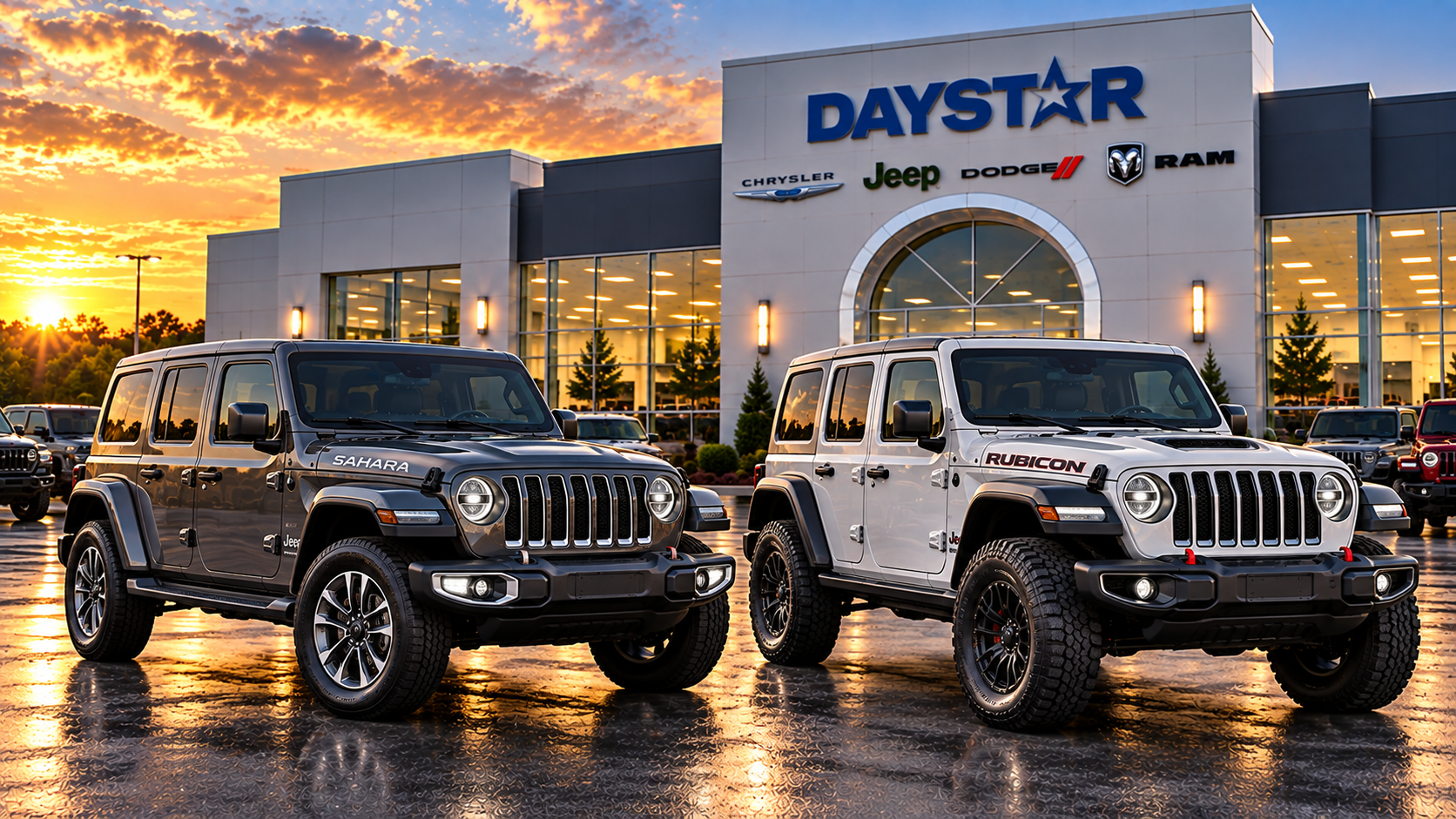
The main difference between the Jeep Wrangler Sahara and Rubicon is their intended driving purpose. The Sahara is built primarily for daily comfort, featuring 18-inch wheels with all-season highway tires, refined cabin appointments, and a Command-Trac 4WD system. The Rubicon is designed for maximum o ff-road capability, adding heavy-duty Dana 44 axles, front and rear electronic locking differentials, an electronic front sway bar disconnect, a Rock-Trac  4WD system with a 4:1 low-range ratio, and 33-inch all-terrain tires. Choosing between these two legendary four-wheel-drive SUVs comes down to how you plan to spend your time behind the wheel. Drivers who spend the vast majority of their week on paved highways, suburban streets, or gravel county back roads usually prefer the Sahara. Available exclusively as a 4-door body style, it delivers smooth highway ride quality, quieter cabin acoustics, and high-end standard convenience items. For buyers interested in plug-in hybrid efficiency alongside premium features, you can also explore Jeep 4xe hybrid options offered on the Sahara platform to find the best fit for your needs. Conversely, the Rubicon is engineered from the frame up to tackle technical rock crawling, steep mud trails, and severe off-road obstacles. Available in both 2-door and 4-door configurations, it sacrifices a small degree of highway softness in exchange for heavy-duty hardware that protects mechanical components when the pavement ends. To help local buyers compare both models side-by-side on identical road surfaces, our team at Daystar Chrysler Dodge Jeep Ram maintains a diverse showroom inventory. You can stop by our Malvern showroom location to walk around both trims, or call (330) 863-1144 to speak directly with our Jeep specialists. Table of Contents How Do Ground Clearance, Axle Ratios, and Sway Bar Disconnects Differ? What Engine and Transmission Options Are Offered on Sahara vs. Rubicon? What Tires Come Standard, and How Do Maintenance and Insurance Costs Compare? What Should Buyers Inspect When Test-Driving a Sahara vs. Rubicon on Paved Roads? Questions Buyers Ask Most About Wrangler Sahara and Rubicon Trims Where Can Buyers Near Malvern Test Drive and Compare Wrangler Sahara and Rubicon Trims? How Do Ground Clearance, Axle Ratios, and Sway Bar Disconnects Differ? The Rubicon provides roughly 11 inches of standard ground clearance, a 4.10 axle ratio, and an electronic sway bar disconnect, whereas the Sahara offers about 10 inches of ground clearance, a 3.45 axle ratio, and a fixed front stabilizer bar. These mechanical variances fundamentally alter how each SUV handles steep inclines, deep ruts, and trail obstacles. Ground clearance differences stem directly from each trim's factory suspension height and tire diameter. The Sahara rides on 32-inch all-season tires that provide ample chassis height for snowstorms and unpaved farm paths around Malvern, while keeping the stepping height manageable for passengers. The Rubicon sits higher from the factory to clear its standard 33-inch off-road tires, and optional factory packages increase tire size to 35 inches for up to nearly 13 inches of total obstacle clearance. Axle gearing and transfer case ratios further separate their mechanical personalities: Sahara Drivetrain: Uses a Command-Trac 4WD or available Selec-Trac full-time system with a 2.72:1 low-range ratio and a 3.45 axle ratio. This setup optimizes engine RPMs for highway fuel economy and smooth acceleration. Rubicon Drivetrain: Uses a Rock-Trac 4WD system with a heavy-duty 4:1 low-range ratio and a standard 4.10 axle ratio (with optional 4.56 or 4.88 ratios). This creates extreme crawl ratios, allowing the vehicle to creep down rocky descents at single-digit speeds without constant brake application. The electronic front sway bar disconnect is exclusive to the Rubicon trim and cannot be equipped on a standard Sahara. By pushing a dash-mounted switch in 4LO or 4HI, the driver mechanically decouples the front stabilizer bar, allowing the front axle to articulate significantly further over boulders and deep ditches to keep all four tires grounded. For shoppers seeking versatile all-weather capability without extreme rock-crawling gear, browsing our pre-owned Jeep Cherokee inventory offers another excellent four-wheel-drive alternative. What Engine and Transmission Options Are Offered on Sahara vs. Rubicon? The Sahara comes standard with a 2.0L turbocharged four-cylinder engine paired exclusively with an eight-speed automatic transmission, while the Rubicon offers multiple powertrains including a 3.6L Pentastar V6 with an available six-speed manual transmission. Buyers seeking three pedals on the floor must choose a V6-equipped Rubicon or lower trim, as the manual gearshift is not offered on the Sahara. Engine specifications across the core lineup deliver strong output tailored to distinct driving styles: 2.0L Turbocharged I-4: Generates 270 hp and 295 lb-ft of low-end torque. Standard on Sahara and available on Rubicon, this motor builds boost quickly for brisk city passing and responsive trail power. 3.6L Pentastar V6: Produces 285 hp and 260 lb-ft of torque. Standard on 2-door Rubicon models and widely available across the 4-door Rubicon line, this naturally aspirated V6 provides linear throttle control and allows pairing with either a six-speed manual transmission or an eight-speed automatic transmission. 6.4L Hemi V8: Reserved exclusively for the range-topping Rubicon 392, delivering 470 hp and 470 lb-ft of torque for maximum acceleration. Both trims deliver a maximum published towing capacity of 3,500 lb when properly equipped with factory receiver hitches and trailer tow packages, making either model capable of hauling light utility trailers, fishing boats, or camper setups. To assist owners in maintaining their drivetrain, our dealership makes it easy to order genuine Mopar parts directly through our service center. We invite local drivers to learn more about our dealership's mission and values as a trusted community automotive partner. What Tires Come Standard, and How Do Maintenance and Insurance Costs Compare? The Sahara comes standard with 18-inch aluminum wheels wrapped in 255/70R18 all-season tires, while the Rubicon features 17-inch wheels mounted to 33-inch BFGoodrich all-terrain or mud-terrain tires. Due to these wheel and tire configurations, the Rubicon generally incurs higher routine maintenance replacement expenses and slightly elevated auto insurance premiums. Comparing long-term ownership costs reveals key operational differences between the two models: Cost Factor Jeep Wrangler Sahara Jeep Wrangler Rubicon Standard Wheel & Tire Size 18-inch aluminum wheels / 32-inch all-season tires 17-inch wheels / 33-inch tires (optional 35-inch) Tire Replacement Cost Moderate (standard highway tread design) Higher (specialized all-terrain/mud-terrain rubber) Tire Tread Wear Rate Longer pavement tread life Faster wear on asphalt due to deep tread blocks Insurance Premium Profile Standard SUV rating tier Slightly higher due to vehicle value & off-road equipment Gearing & Highway Fuel Use 3.45 axle ratio (optimized highway MPG) 4.10 axle ratio (higher engine RPM at 70 mph) Because the aggressive tread compounds on 33-inch or 35-inch off-road tires wear down faster on dry pavement, Rubicon owners who commute daily will replace tires more frequently than Sahara owners. Additionally, full-replacement costs for heavy-duty all-terrain tires run noticeably higher per set. Insurance underwriters typically assign slightly higher physical damage premiums to the Rubicon because of its higher initial purchase price, specialized electronic locking differentials, and increased exposure to off-road trail damage risks. What Should Buyers Inspect When Test-Driving a Sahara vs. Rubicon on Paved Roads? When evaluating a Sahara and a Rubicon on a paved test drive, buyers should pay close attention to tire hum, cabin wind noise, steering tracking on the highway, and suspension firmness over rough patches. The mechanical differences that make the Rubicon an off-road powerhouse create noticeable differences on blacktop. Our team recommends executing a specific evaluation checklist during your test drive: Highway Cruise Stability: Drive both vehicles at 65 to 70 mph along local state routes, such as the corridors through Minerva. Notice how the Sahara holds its lane with minimal steering correction, whereas the Rubicon 's taller stance and softer, knobby off-road tires require subtle steering inputs to maintain center. Cabin Noise Levels: Pay attention to ambient cabin sound at speed. The smooth highway tread on the Sahara keeps tire roar to a minimum. In contrast, the deep tread voids on the Rubicon 's 33-inch tires produce a distinct rhythmic hum that increases with vehicle speed. Suspension Dampening over Bumps: Pass over railroad tracks, expansion joints, or uneven pavement. The Sahara absorbs sharp impacts with a compliant, passenger-car-like dampening style. The Rubicon responds with a firmer, heavy-duty truck feel designed to withstand severe off-road bottoming. Turning Radius and Parking Effort: Test low-speed maneuvering in a parking lot. The Sahara turns smoothly with tight wheel articulation, while the Rubicon 's wider track and heavy-duty front axle components feel slightly heavier at the steering wheel. Shoppers interested in exploring our current factory-fresh inventory can view our online new Jeep Wrangler Rubicon selection before arriving for a road test. Questions Buyers Ask Most About Wrangler Sahara and Rubicon Trims Q: Is the Wrangler Sahara or Rubicon better for a daily commute? The Sahara is generally better suited for daily commuting because its 18-inch all-season tires, 3.45 axle ratio, and highway-tuned suspension provide a quieter cabin, smoother ride, and better pavement tracking. While the Rubicon can certainly be driven daily, its knobby 33-inch tires generate more road noise and wear faster on asphalt. Q: Does the Jeep Wrangler Sahara have a manual transmission option? No, the Sahara is offered exclusively with an eight-speed automatic transmission paired with the 2.0L turbocharged four-cylinder engine or 4xe plug-in hybrid powertrain. If you want a six-speed manual transmission, you must choose a Rubicon or Sport model equipped with the 3.6L Pentastar V6 engine. Q: Can I add the Sway Bar Disconnect feature to a Sahara trim? The electronic front stabilizer bar disconnect is a factory feature exclusive to the Rubicon trim and is not available from the factory on a Sahara. While aftermarket manual disconnect links can be installed on a Sahara, the push-button electronic system integrated into the dash and Uconnect display is unique to Rubicon models. Q: What mechanical warranty coverage comes on both Wrangler trims? Both the Sahara and Rubicon come backed by Jeep's standard factory warranty package, which includes a 3-year/36,000-mile basic limited warranty and a 5-year/60,000-mile powertrain limited warranty. Rust-through corrosion protection is covered for 5 years with unlimited mileage. To help plan your purchase around your monthly household budget, you can apply for competitive financing online prior to visiting our dealership. Q: How does choosing a Wrangler fit into environmental initiatives? Selecting a 4xe plug-in hybrid version of either the Sahara or Rubicon allows drivers to complete daily short-distance trips using purely electric power while retaining full four-wheel-drive trail capability. Customers can also learn about our carbon neutral program to explore how our dealership supports sustainable automotive practices. Where Can Buyers Near Malvern Test Drive and Compare Wrangler Sahara and Rubicon Trims? Buyers near Malvern can test drive and compare the full lineup of Jeep Wrangler Sahara and Rubicon models at Daystar Chrysler Dodge Jeep Ram. Located right on Alliance Road, our dealership regularly stocks both 2-door and 4-door configurations, including standard gas engine options and advanced 4xe plug-in hybrids. Evaluating both trims back-to-back on identical local roads is the absolute best way to decide which model fits your personal lifestyle. Whether you prefer the refined highway comfort of the Sahara for daily family driving or the heavy-duty Dana 44 axles and locking differentials of the Rubicon for weekend trail rides, our experienced team provides clear, straightforward guidance with zero pressure. When you are ready to take the next step: Visit our dealership address at 7157 Alliance Rd NW, Malvern, OH 44644 to compare vehicle windows, cabin features, and seating layouts. Give our sales team a call at (330) 863-1144 to confirm current vehicle availability or schedule a dedicated back-to-back road test. Bring your trade-in vehicle along so our appraisal team can provide a transparent market valuation while you are out on your test drive. © 2026 Daystar Chrysler Dodge Jeep Ram. All rights reserved. br>

Contact Us

Fill out this form below and we'll contact you shortly
*Required Fields